

Surviving the Monster in My Pool
And why the recovery took longer than the emergency itself

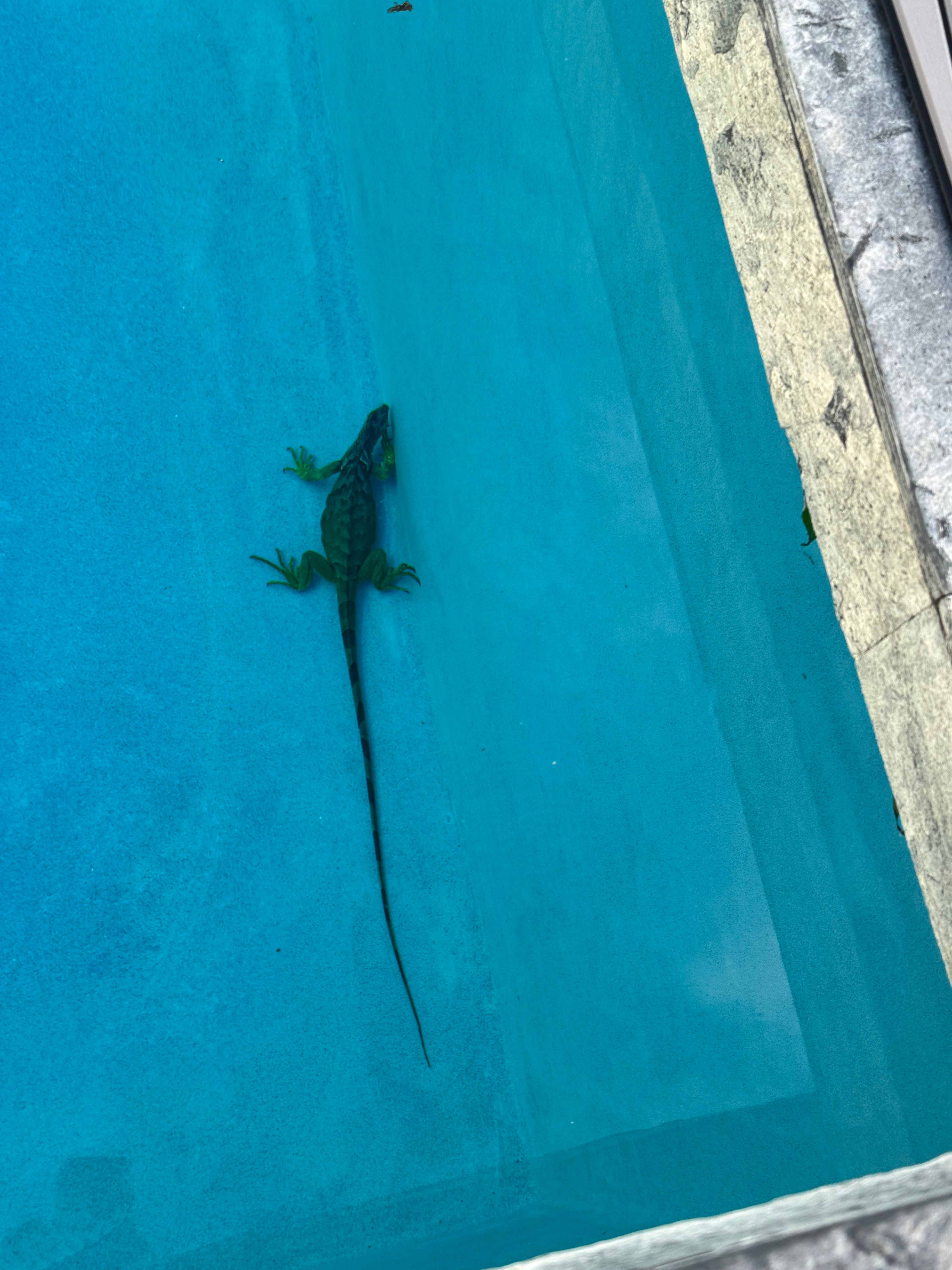
I stepped onto the patio Sunday evening and was surprised to lock eyes with an iguana.
Apparently we were both startled. After a beat, it took a flying leap into the pool.
The edge of the pool has a lip. The iguana couldn’t figure this out and thrashed around a bit before deciding to chill at the bottom. At which point, I did what any sane person would and called for help.
In Florida, iguanas are an invasive species. Removal is both legal and, in this area, not even slightly remarkable. My neighbor arrived with what I will call reinforcements and a plan. (Yes, he’s a very good neighbor, I know.)
The details involve a very undignified iguana. I’ll leave it at that.
What I will tell you is that by the time I was cleaning up, I still felt edgy and jumpy. My heart rate was up. I was laughing, and also somehow still wired.
The iguana was gone, but my nervous system had not gotten the update.
My Body Staged a Full-On Emergency
When something unexpected and alarming occurs, your body stages an acute stress response. Doesn’t matter if that “something” turns out to be fine. Is it a funny story by the next day? Great. But in the moment? Doesn’t matter.
This is your threat-detection system doing exactly what it was built to do.
As soon as your brain registers something alarming, your hypothalamus fires. Stress hormones start flooding your bloodstream. Your heart rate climbs, blood vessels constrict, digestion pauses, and your muscles prime for action. Your body does not wait for additional information. It responds first and processes later.
This is the system that kept our ancestors alive.
The problem is that it makes no distinction between threats that require sprinting and threats that require standing in your backyard watching your neighbor show an aquatic rodent who’s boss. The cascade is the same. And once you’re activated, the recovery often takes longer than the event!
Adrenaline has a half-life. Once it’s in your bloodstream, it doesn’t disappear the moment the stressor is resolved. It circulates and eventually dissipates until something comes along to bring it back up.
Of course, something always does.
This is why you can know, intellectually, that everything is fine but still feel edgy or off, after the “threat” has passed. You’ve still got more adrenaline coursing through you than you did before encountered that threat.
“It’s Fine” is Not Medicine
The instinct after a stress spike is to reassure yourself. It’s over. I’m safe. That was nothing. And while that’s true, it’s directed at the wrong audience.
Because the amygdala – the part of your brain managing the alarm system – doesn’t simply respond to rational reassurance. It responds to physiological signals more easily and quickly.
This is why you can’t simply decide to stop feeling anxious. The cognitive layer and the nervous system layer are running separate processes. To actually bring the stress response down, you need to send a signal the body understands.
The most direct signal available to you is your exhale.
A Signal That Actually Works
Nadi Shodhana, a Sanskrit term which translates roughly to “channel purification”, is one of the most studied yogic breath techniques for reducing acute physiological arousal. It sounds complicated, but really, it’s just alternate nostril breathing.
Mechanically, the alternating pattern creates a slow, deliberate rhythm that engages the parasympathetic branch (the “rest and digest” side of your autonomic nervous system) while the nostril switching requires just enough focused attention to interrupt the looping thoughts that often follow a stress spike. Some studies have even shown that it can lower your heart rate and blood pressure.
Sitting comfortably, your right thumb to close your right nostril. Inhale slowly and fully through your left nostril.
At the top of the inhale, close your left nostril with your right ring finger, releasing your thumb. Exhale slowly through your right nostril.
Then inhale through the right nostril. Close the right nostril again with your thumb, release the ring finger, and exhale through the left nostril.
Keep going back and forth for 5-10 rounds. If you like it, then keep going.
How many counts per breath?
Start with 4 in, 4 out. You can extend the exhale to 6 counts if you want to go deeper; the longer exhale increases the parasympathetic signal. To go even further, once you’re a little used to it you can start adding a brief hold between each inhale and exhale.
You’re likely to notice a gradual slowing. You might feel your heart rate drop and your thoughts cycling a little less fast. Not because you talked yourself out of anything, but because you gave your body a signal it actually responds to.
Try it the next time something alarming happens. Your nervous system will catch up. It just needs a little help getting started.
Last Gasp
“The crisis of today is the joke of tomorrow.”
— H.G. Wells
P.S. If you’d like more practices for the moments when your body needs a signal – not a pep talk – my free newsletter goes out each week with science, techniques, and usually something that makes you think. Get it here.
This is gold, Candice. I’m going to use it on repeat to survive the roller coaster of each week. Thank you! (And wow about the iguana. To this desert gal, that sounds terrifying!)
That is a biiiigggg aquatic rodent!! 🫣. Super helpful post, Candace 💕. And to think- you need only step out into the backyard for inspiration 😬